
How does a mechanical calculator work?
Carry operation, place-value dials, and wooden gear mechanisms — including a DIY mechanical calculator kit
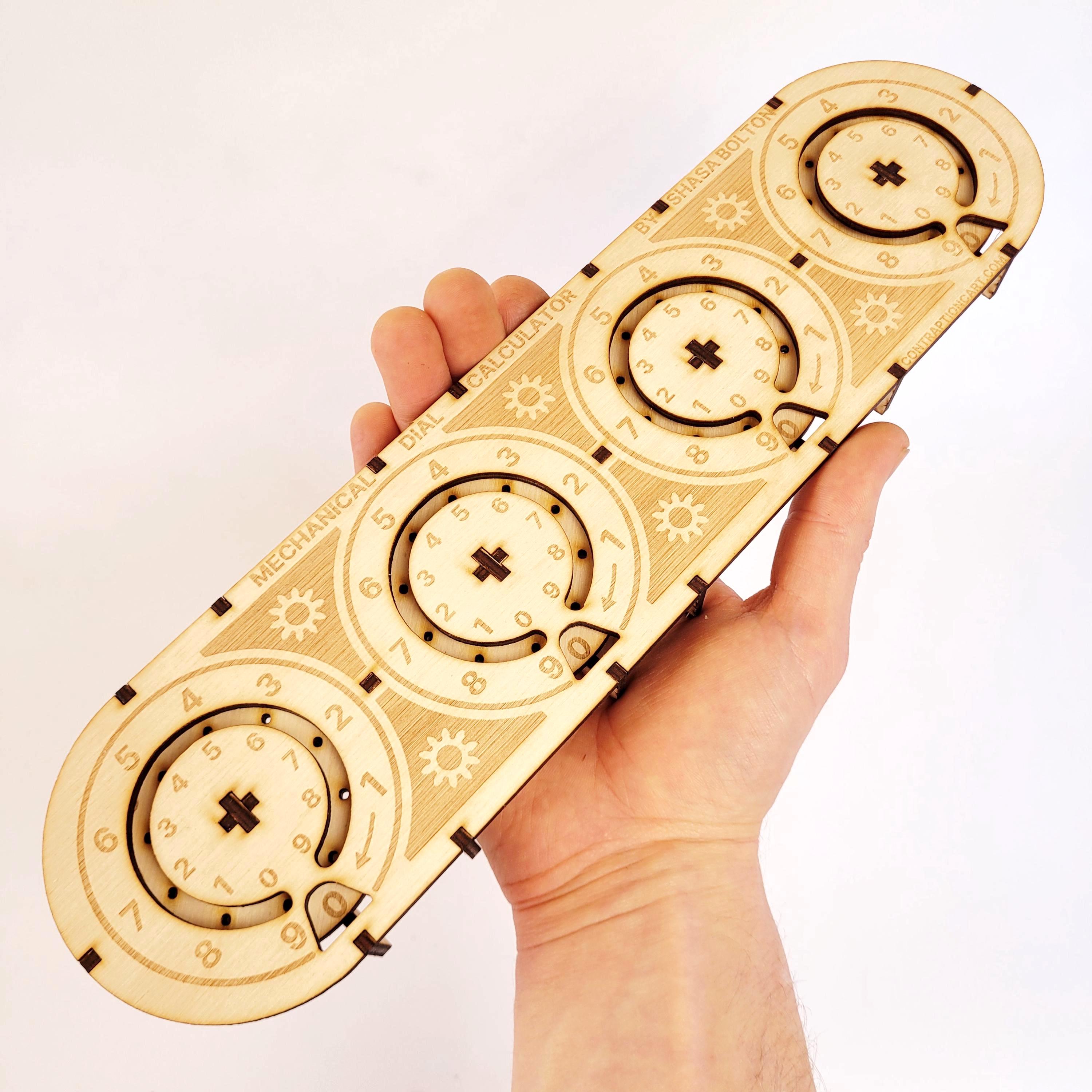
Before electronic computers, mechanical calculators performed arithmetic with gears and dials. I designed a wooden mechanical calculator that works the same way — a hands-on STEM toy for demonstrating place value and the carry operation in arithmetic.
The fundamental requirement of any mechanical calculator is the carry operation. When a number dial passes above 9, it must return to 0 and add 1 to the place-value dial above it. This must also happen in reverse: when a dial passes below 0, it returns to 9 and subtracts 1 from the dial above. With carry working in both directions, the machine can perform addition, subtraction, multiplication, and division.
This mechanical calculator has four dials — one for each place value (ones, tens, hundreds, thousands). Each dial shows the digits 0 to 9, so the transition from 9 to 0 and from 0 to 9 is handled simply by the circular dial. The question is: how do we perform the carry to the next place value up?
The answer is a single gear tooth on each dial. Whenever the dial passes between 9 and 0, that tooth engages the wheel above and turns it by one tenth, adding or subtracting 1.

The video below demonstrates addition and subtraction on the wooden calculator. Read on to learn how to extend these operations to multiplication and division.
Advanced operations
What I like about this machine is how it makes intuitive that more advanced operations are built from the fundamental ones. Once you understand addition and subtraction, multiplication and division follow naturally.
Multiplication
Multiplication is essentially repeated addition.
Example: 3 × 7
1. Set the machine to 0.
2. Add 3 repeatedly, counting as you go: 1, 2, 3…
3. Stop when you reach 7.
4. Read the answer: 21.
Division
Division is essentially repeated subtraction.
Example: 22 ÷ 3
1. Set the dials to show 22.
2. Subtract 3 repeatedly, counting as you go: 1, 2, 3, 4…
3. When the machine displays a number smaller than your divisor, stop subtracting. Count. …5, 6, 7.
4. You should now read the value 1 on the machine. This is smaller than 3, so stop subtracting.
5. Your count equals the answer and the number on the machine is the remainder. So 22 ÷ 3 = 7 remainder 1.
I sell the mechanical calculator as a pre-cut kit you assemble in under an hour, or fully assembled and ready to use. It is a great hands-on way to explore mechanical computing, place value, and gear mechanisms — recommended for ages 8 and up.
Frequently asked questions
How does a mechanical calculator work? Each place-value dial shows digits 0–9. When a dial passes from 9 to 0, a gear tooth advances the dial above by one tenth — the carry operation. With carry in both directions, the machine handles all four arithmetic operations.
What is the carry operation? Carry is what happens when a digit dial rolls past 9 back to 0 and adds 1 to the next dial up — or rolls below 0 to 9 and subtracts 1. It is the key to multi-digit arithmetic on a mechanical calculator.
Can this calculator do multiplication and division? Yes. Multiplication is repeated addition and division is repeated subtraction — both are demonstrated step by step above.
How many digits can it handle? Four place-value dials, for addition and subtraction up to 9,999.
How long does it take to build? Under an hour. Available as a kit or fully assembled.
Mechanical Calculator
AUD$50.00